.svg)

.svg)

.svg)
Euno acts as the best
metadata catalog
interface we have for
exploring metrics, their
definitions and their
availability in data assets.”

in action?
At a glance
Bolt operates one of Europe’s fastest-growing mobility platforms, supported by a large and evolving data ecosystem spread across many product domains.
Analytics Engineering Manager, Silja Märdla, leads the effort to bring clarity and consistency to this landscape, ensuring teams work with well-defined, trustworthy metrics.
{{author}}
Growing fast without losing confidence
Every fast-growing company hits the same crossroads: scale the business or govern the data. Bolt, one of Europe’s fastest-growing mobility platforms, has chosen to do both, at once.
With thousands of models, dashboards, and data assets spread across dozens of teams, Bolt’s analytics engineering organization needed a way to preserve trust and clarity without slowing the business.
“We operate in a hybrid data mesh, each team owns its own data, but we still need shared standards and governance to keep everything aligned.”
But even the best data catalogs fail if no one uses them. For Bolt, success meant ensuring adoption across data teams and gradually expanding that trust to the wider business.
Bolt’s data stack is complex: Databricks, Airflow, dbt, Looker, Fivetran, and several data catalog tools, six in total, including Euno and DataHub.
At that scale: 15 000 + dashboards, 4 000 + dbt models, thousands of tables, the biggest challenge wasn’t infrastructure, it was consistency.
“Analysts spent valuable time reconciling metrics. Ownership was uneven. And as the company expanded into new products, so did the complexity of its data landscape.”
Thinking in metrics, not tables
The analytics engineering team decided to rethink how they modeled data.
“We stopped thinking in tables and columns and started thinking in entities and metrics, each metric now has a clear definition, an owner, and a process for change.”
To make that approach work in practice, the team needed technology that could synchronize dbt and Looker and provide true end-to-end visibility across the data model, including the ability to ask complex, multi-layered questions that combine ownership, lineage, and usage in one view.
Leveraging Euno as the connective layer
The analytics engineering team decided to rethink how they modeled data.
{{quote-1}}
After Euno’s sync went live:
The impact:
Making Euno part of the everyday workflow
Today, Euno is deeply embedded across Bolt’s data organization. Analytics engineers and data analysts rely on it daily for discovery, lineage, and governance, and adoption continues to grow every quarter.
{{quote-2}}
The next phase is rolling it out to business users, gradually expanding access and awareness so that non-technical teams can also explore data confidently and find trusted assets on their own.
Exploring data deeply with Euno queries
One of the most powerful aspects of Euno for Bolt is its data model querying capability. It allows analytics engineers to explore relationships across layers and ask complex, multi-level questions about how data flows from the data sources all the way to Looker charts, including transformation logic, ownership, usage, and dependencies.
For example, an engineer can now ask:
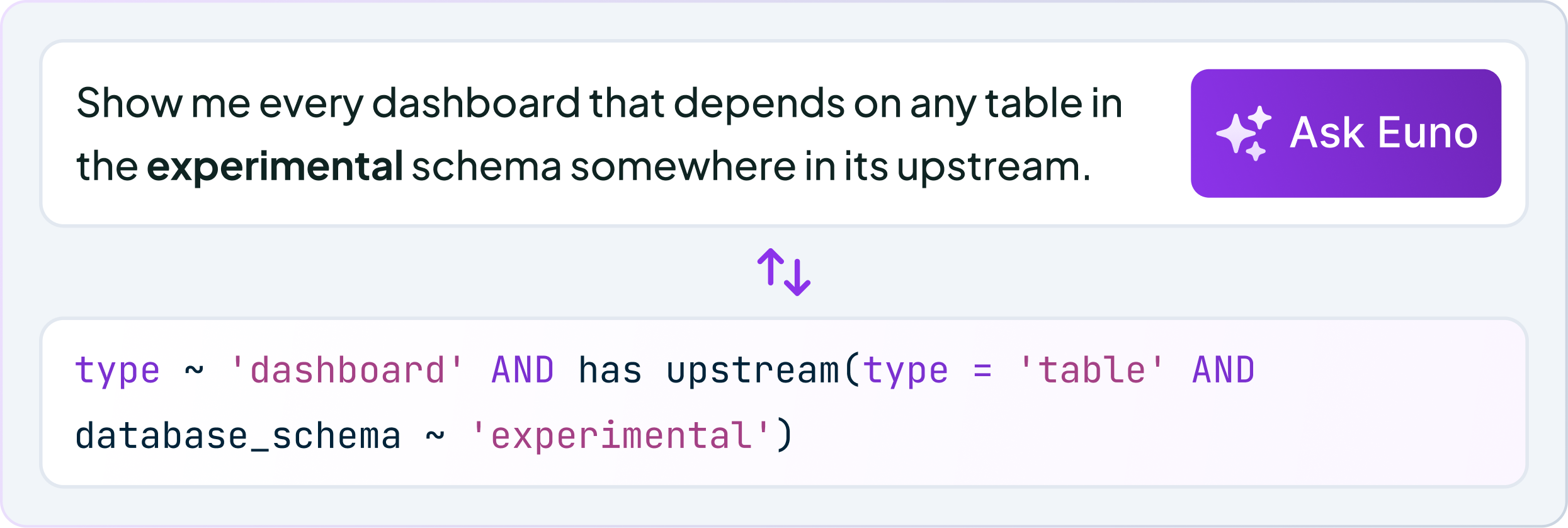
That depth of visibility has transformed how Bolt understands lineage. Instead of manually tracing dependencies, the team can instantly map how one model influences another, where metrics originate, and how they’re used downstream.
{{quote-3}}
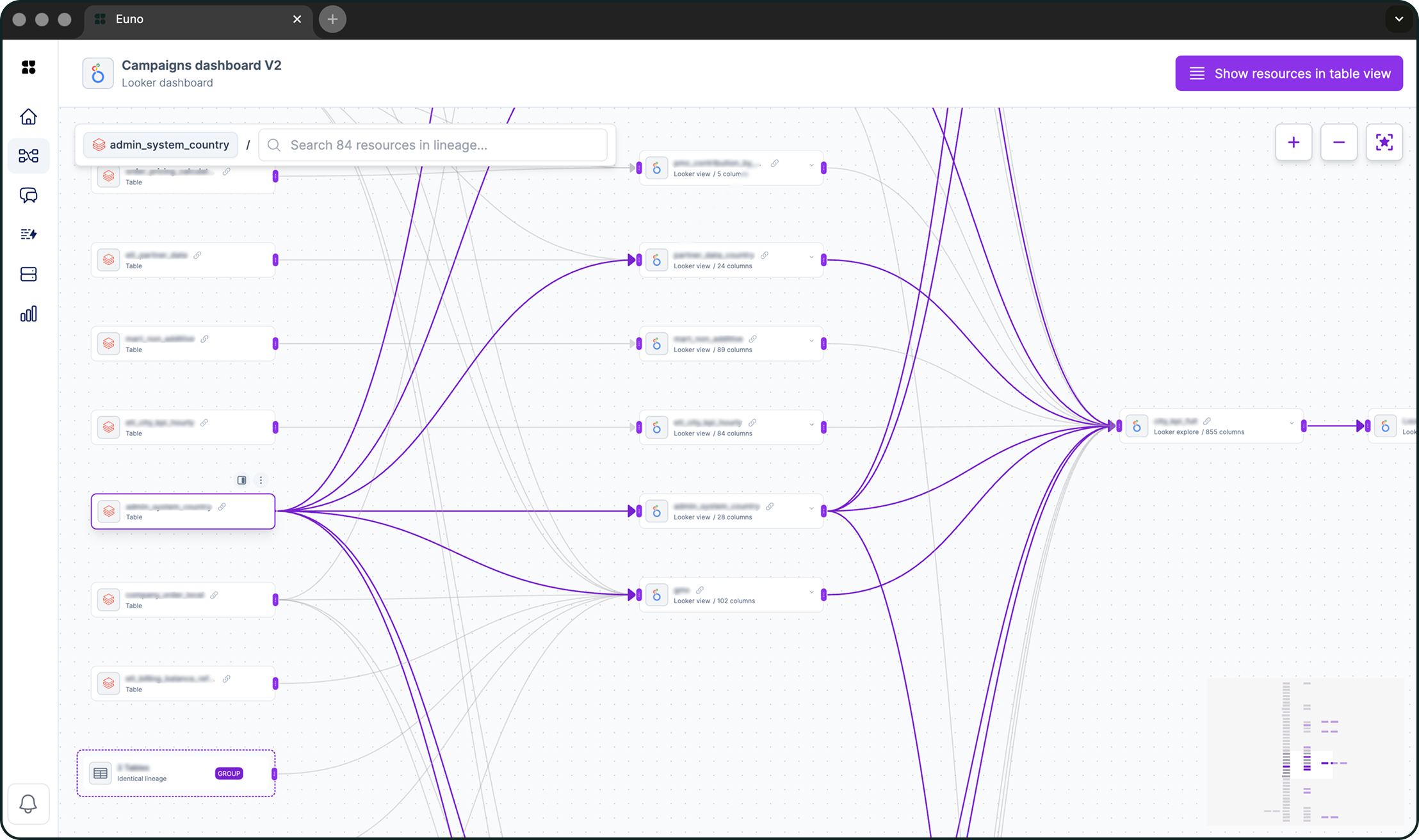
Silja is especially excited about Euno’s new DAG view, which visualizes lineage in a clean, interactive way: “It simplifies lineage exploration, I can see the dependencies right away, without digging through multiple tools. They let us go deep into the data model, but more importantly, they let us isolate the specific paths we’re looking for from the very large data model we have.”
AI-ready data governance
Bolt’s next frontier is enabling self-serve analytics powered by AI through Databricks Genie, Looker agents and other similar tools, without sacrificing trust.
{{quote-4}}
Euno’s lineage and usage insights are key to that plan, helping Bolt identify which models are most valuable and keep them up-to-date. Euno automated classification mechanism will mark assets as ‘AI-ready’, ensuring reliability before exposure to AI systems.
This deep context can be now surfaced to AI agents in real time via Euno’s MCP server, meaning Bolt’s investment in governance will have a direct impact on AI success, turning trusted data foundations into reliable AI outcomes.

Euno plays two main roles for us, it syncs dbt with Looker to keep everything consistent.
It acts as the best metadata catalog interface we have for exploring metrics, their definitions and their availability in data assets.”
Euno is already deeply used across our analytics teams, now we’re starting to share it more broadly, helping business users access and explore data the same way.”
The queries in Euno are incredibly powerful. They let us go deep into the data model, but more importantly, they let us isolate the specific paths we’re looking for from the very large data model we have.
Euno helps you do the governance work you should be doing anyway, it just makes it more convenient.
.png)
.png)